World's Best Litter Review (2026)
World's Best Cat Litter review: we examine the corn formula, flushability claims, odor control, dust, and honest limits, plus the real flushing rules.
Quick answer
World's Best Cat Litter is the most credible corn-based litter on the market: whole-kernel corn that clumps naturally, controls odor with corn enzymes instead of fragrance, and is dramatically lighter than clay. The flushability claim is real per the manufacturer — they claim septic safety too, citing lab testing — but it comes with honest limits (plumbers remain skeptical, and many local rules discourage flushing cat waste entirely). It's our pick for buyers leaving clay behind, with caveats on tracking, price, and clump softness below.
Product overview: what's actually in the bag
World's Best Cat Litter is made by Kent Pet Group from whole-kernel corn — a renewable, farm-grown material, not a mined one. The clumping mechanism is the key thing to understand: instead of sodium bentonite (the clay mineral that swells in traditional litter), World's Best uses the natural starches in corn to form clumps when wet. The starches absorb moisture and bind together, creating scoopable clumps.
Odor control comes from natural corn enzymes rather than added fragrance or baking soda — the unscented formula relies on the material itself. The manufacturer also markets the litter as flushable and septic-safe, lightweight (a fraction of clay's density per scoop), and available in several formulas: the original Clumping, Multi-Cat Clumping (tighter clumps for busier boxes), and a Lavender-scented variant for buyers who want fragrance.
Practical details: it's sold in bags from small trial sizes up to large multi-cat bags. Usage directions are standard — fill 3–4 inches, scoop daily — with one extra instruction from the manufacturer: don't overfill, because corn litter works best at moderate depth where clumps can form without excess material. For the brand's full lineup, see our World's Best brand guide, and for how corn litter compares to the alternatives, our guide to types of cat litter.
The flushability claim, examined
The headline promise — flushable — is what sets World's Best apart from every clay litter, so let's take it apart honestly.
What the claim is based on. Unlike clay, which does not break down in water and will absolutely clog pipes, corn starch dissolves. The manufacturer markets the litter as flushable and septic-safe, and the material science is on their side: corn-based clumps break apart in water in a way bentonite clumps never will.
Where the claim needs honest limits. Four of them:
- Sewer vs. septic is the big one. "Septic-safe" is the manufacturer's wording, but plumbers and septic professionals are near-unanimous: don't flush cat litter into a septic system. Septic tanks rely on bacterial balance and slow settling; even dissolvable litter adds solids the system wasn't designed for. Sewer systems (municipal wastewater) are the only context where flushing is even a conversation.
- Cat feces carry Toxoplasma gondii. This is the environmental caveat most flushable-litter marketing skips. The parasite's oocysts can survive standard wastewater treatment, which is why many municipalities and environmental agencies discourage flushing cat waste entirely — it's a documented threat to marine mammals and a public-health concern. Flushing urine clumps is a different risk profile than flushing feces; many buyers flush clumps and trash feces.
- Local regulations vary. Some jurisdictions explicitly prohibit flushing pet waste. The manufacturer's claim doesn't override your city's rules — check before you flush.
- Quantity matters. Even dissolvable litter can cause problems flushed in bulk. Buyers who flush successfully do it in small amounts with plenty of water, never a full box change.
The honest verdict on the claim: the flushability is materially real — corn dissolves, clay doesn't — but "flushable" is not a recommendation to flush everything. Our full breakdown lives in the guide on whether you can flush cat litter. If you're on septic, we'd still treat this as a great trash-disposed litter — the manufacturer's septic claim covers the litter, not your system's condition.
Clumping, odor, dust, and tracking
Clumping is good for a plant-based litter, with one honest qualifier: corn clumps are softer than premium clay clumps. They scoop cleanly when fresh and given a moment to set, but they don't have the rock-hard integrity of bentonite. Buyer consensus: scoop gently, don't dig aggressively, and the Multi-Cat formula's tighter clumps are worth it for busier boxes. If you switch from a hard-clumping clay, adjust your scooping technique — this is the most common adjustment complaint from new buyers.
Odor control is genuinely solid for a natural litter. The corn enzymes handle ammonia respectably in single-cat boxes, and the unscented formula means there's no fragrance competing with the cat's nose or yours. Where it trails premium clay is the heavy multi-cat box: formulas built on baking soda seals or activated carbon (like our top clay picks) hold odor longer under high waste volume. For one or two cats with daily scooping, most buyers report odor control they consider comparable to mid-tier clay.
Dust is low — another real advantage over clay. There's no fine mineral dust cloud on the pour, which allergy households notice immediately. It's not crystal-level dust-free, but it's meaningfully cleaner than conventional clay.
Tracking is the weak spot. The lightweight granules that make the bag easy to carry also make them easy for paws to carry out of the box. This is the most consistent complaint across buyer reviews: expect more tracked granules than with clay, and budget for a good litter mat. The granules are at least soft and easy to sweep — small consolation, but real.
Lightweight: the real advantage and the real trade-off
World's Best markets the lightweight formula heavily, and it's not marketing fluff — a bag of corn litter is dramatically lighter than the same volume of clay. If you haul litter up stairs, have a bad back, or just hate the 37-lb clay box, this is a quality-of-life upgrade that's hard to overstate.
But lightweight cuts both ways, and the trade-off is physics: light granules track more, scatter more, and are easier for an enthusiastic digger to fling. Everything that makes it easy to carry makes it mobile in the box. Buyers who love the weight and hate the tracking solve it the same way: a deep-groove mat, a high-sided box, and accepting that sweeping is part of the deal. Go in clear-eyed and it's a fair trade.
Who it's for — and who should skip it
- Whole-kernel corn — renewable, no clay mining, non-toxic if tasted
- Naturally clumping without bentonite; genuinely scoopable
- Dramatically lighter than clay to carry and pour
- Good odor control for a plant-based litter, unscented
- Materially flushable in sewer systems (see limits above)
- Lightweight granules track more than clay — mat required
- Clumps are softer than premium clay; scoop gently
- Premium price vs. conventional clay litters
- Flushing has real limits: check local rules; septic users should stay cautious
- Some cats dislike the texture — transition gradually
Buy it if: you want out of clay (environmental reasons, dust, or weight), you have one or two cats with a daily scooping routine, and you're on a sewer system where the flushability is a genuine bonus. It's also one of the better kitten options past the mouthing stage, since the corn formula is non-toxic if tasted.
Skip it if: you're on septic and want zero plumbing risk (the manufacturer claims septic safety, but we recommend trash disposal on septic), your cat is a vigorous digger in a carpeted room (the tracking will drive you mad), you need maximum odor headroom for a heavy multi-cat box, or your cat has already rejected plant-based textures. And if anyone in the household has a corn or grain allergy — rare, but real — this is a hard no.
Common complaints: what buyers actually grumble about
No litter is complaint-free, and the recurring gripes about World's Best are worth knowing before you commit:
- Tracking. The #1 complaint by a wide margin. Lightweight corn granules hitchhike on paws and scatter from enthusiastic digging. A mat helps; it doesn't eliminate it.
- Soft clumps. Buyers switching from hard-clumping clay consistently note the clumps are softer and need a gentler scoop. Digging aggressively breaks them apart.
- Price. It costs meaningfully more than conventional clay, and the price-per-pound math stings for multi-cat homes going through bags quickly.
- The "flushable" fine print. Some buyers report being surprised that flushing has limits — the septic question, local rules, the feces question. The marketing leads with "flushable"; the reality has footnotes (which we've given you above).
- Texture rejection. A minority of cats refuse the corn texture outright. Transition over a week or two by mixing with the old litter rather than switching cold.
- Bag storage. Like other grain-based litters, it should be stored sealed — both to keep it fresh and because grain products can attract pantry pests if left open.
Getting the most out of it: the routine for corn litter
Corn litter rewards a slightly different routine than clay. Here's the pattern buyer reports suggest works:
- Don't overfill — 2–3 inches is the sweet spot. The manufacturer specifically warns against overfilling; excess depth works against corn's clumping mechanism.
- Let clumps set before scooping. Give fresh clumps a few minutes to firm up rather than scooping the instant you see them. Patience is the difference between clean scoops and crumbles.
- Scoop gently. Slide the scoop under clumps rather than digging. The softer clump structure rewards finesse.
- Scoop daily, flush or trash thoughtfully. Urine clumps in small amounts with plenty of water if you're on sewer and local rules allow; feces go in the trash (the parasite question); everything goes in the trash on septic.
- Store the bag sealed. Keeps the litter fresh and avoids attracting pantry pests.
 Our pick
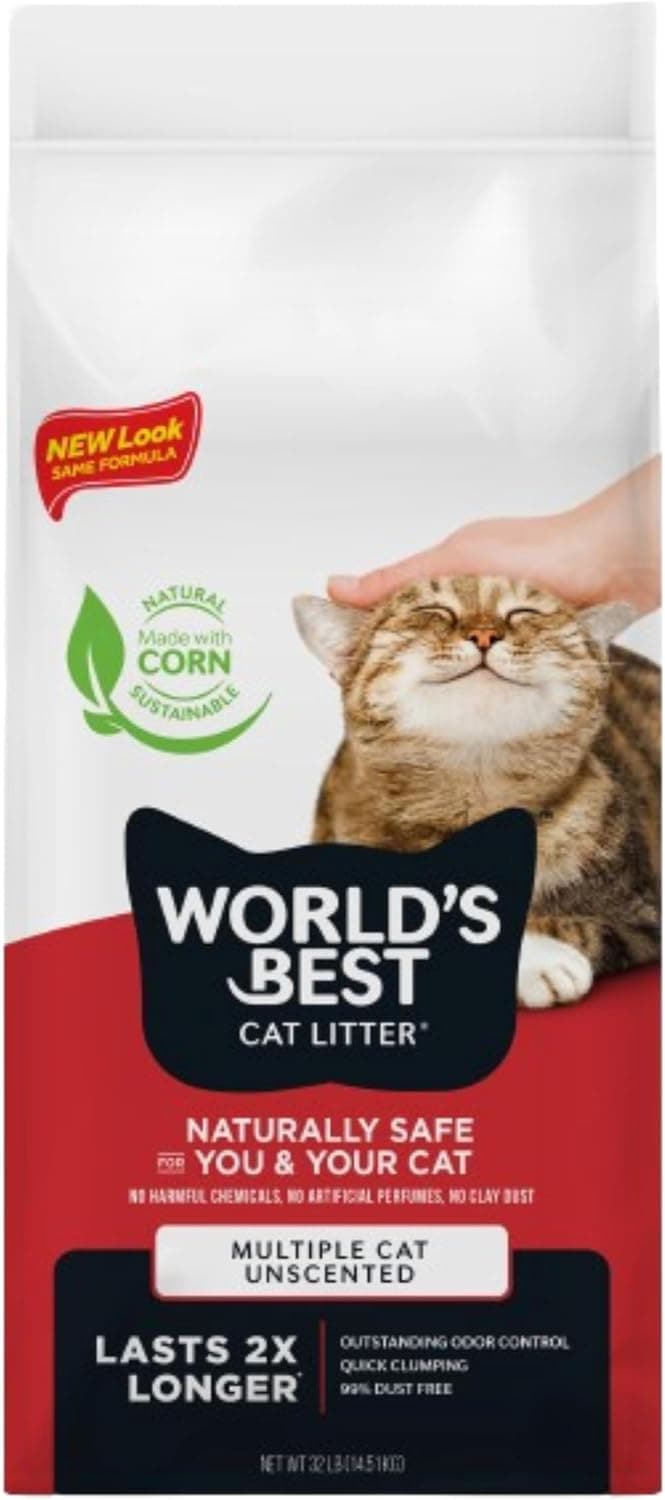
World's Best Multi-Cat Clumping Cat Litter
Whole-kernel corn litter — natural clumping, lightweight, flushable
Our verdict
World's Best Cat Litter earns our pick for buyers leaving clay behind: the corn-based clumping is genuinely scoopable, the odor control is solid for one-to-two-cat homes, and the lightweight bag is a real quality-of-life win. Just go in clear-eyed — the granules track, the clumps are softer than clay, and "flushable" comes with check-your-local-rules footnotes (plus our caution on septic). For the right household, it's the best natural litter on the market.
How we researched this review
We don't pretend to lab-test litter in a basement. This World's Best Cat Litter review is a research-based assessment built from three sources:
- Manufacturer documentation — Kent Pet Group's published claims, usage directions, and formula details.
- Retailer specifications — bag sizes, formula variants, and category positioning from major pet retailers.
- Themes from verified buyer reviews — recurring patterns across large numbers of customer reports, not cherry-picked quotes.
Where something is a manufacturer claim rather than independently verified, we say so. Where buyer experience splits, we say that too. No invented ratings, no fabricated test anecdotes. The flushability section gets extra scrutiny because it's the claim most likely to cause a plumbing bill.
Sources
- World's Best Cat Litter — Is It Flushable? (official) — the manufacturer's flushability and septic-safety claim, citing independent lab testing (1–2 clumps at a time)
- UC Davis School of Veterinary Medicine — Toxoplasmosis & cat waste (PDF) — "don't flush kitty litter down the toilet — sewage treatment may not kill Toxo eggs"; bag waste and trash it
Frequently asked questions
Part of our Types of Cat Litter: Complete Guide hub — start there for the full overview.
Keep reading
Affiliate disclosure: The Litter Logic earns a commission when you buy through links on this page — at no extra cost to you. It keeps our guides free and independent. As an Amazon Associate I earn from qualifying purchases. Read our full disclosure.