
PetPivot AutoScooper 11 Review (2026)
PetPivot AutoScooper review (2026): the budget self-cleaning box vs the Litter-Robot 4 — cleaning mechanism, safety, litter fit, and real buyer complaints.
Quick answer
The PetPivot AutoScooper 11 is the budget route into self-cleaning litter boxes: an open-top, app-connected unit with an automatic rake that clears the litter bed after each use, priced in the budget tier — a fraction of what the premium tier costs. It genuinely eliminates daily scooping, which is the whole point. But "cheaper" shows up in the details: a less refined raking mechanism, a smaller waste capacity, a simpler app, and a shorter company track record. Worth it for budget-constrained one- or two-cat homes; not a lifetime appliance.
Product overview: what the AutoScooper 11 actually is
PetPivot positions the AutoScooper 11 as the accessible end of the self-cleaning category: an open-top automatic litter box where, instead of you scooping, a motorized rake does it. No enclosed globe, no complex rotation — the cat uses a familiar open litter bed, and after a delay, a comb-like rake sweeps through the bed, carries clumps into a waste compartment, and the bed is clean again.
That open-top design is doing real work beyond cost. The #1 reason automatic boxes get returned is the cat refusing an enclosed or moving chamber — the open bed removes the enclosure objection entirely, so cats that rejected globe-style boxes often accept this one without drama. The trade-off is odor containment: an open top is an open top, and this unit relies on frequent cycling rather than enclosure to keep smell down.
It's also app-connected — scheduling, cycle controls, and status notifications via a companion app — which budget boxes historically skipped. The app is simpler than the premium-tier ecosystems (more on that below), but its presence at this price tier is the point: the basics of a smart self-cleaning box, minus the flagship polish.
How the cleaning cycle works
The cycle is simpler than a globe-sifting mechanism, which is both the appeal and the limitation:
- The cat uses the box and leaves. Sensors detect presence so the unit knows not to start mid-visit.
- Wait timer. After the cat exits, the unit waits — long enough for clumps to firm up. This matters more for rakes than for sifters: a rake dragging through a soft clump smears it instead of lifting it.
- The rake sweeps. The comb passes through the litter bed from one end to the other, carrying clumps (too large to pass through the comb's gaps) into the waste compartment. Clean litter falls back through.
- Reset. The rake returns to its home position. The bed is level and ready.
What this means in practice: the box is clean after every cycle without you touching a scoop. The failure mode to know about is the same one every rake-based box shares — the mechanism depends on clumps being firm enough to survive being dragged. Soft clumps (wrong litter, too-short wait, humid air) break apart in the comb, and the rake returns fragments to the bed. Most "it doesn't clean well" complaints trace back to litter choice and timing, not the motor. Our best litter for automatic litter boxes guide ranks formulas on exactly this.
Litter compatibility: clumping clay or nothing
Same hard rule as every automatic box: the AutoScooper 11 needs standard clumping clay. The rake's comb is calibrated for the granule size and clump behavior of clay. Non-clumping clay, crystal litter, pine pellets, paper litter, and walnut shells don't work — they either fall through the comb wrong, don't clump at all, or jam the rake track. Lightweight litters are problematic too: they're dusty in an open bed and can confuse the sensors.
Practical guidance from buyer experience:
- Use a standard-grain clumping clay, unscented. Hard-clumping formulas perform best because firm clumps survive the rake.
- Respect the fill line. Too much litter and the rake plows instead of sweeping; too little and clumps can't form properly.
- Give the wait timer time. This is the single biggest lever on cleaning quality — firm clumps are everything for a rake.
- Top up regularly. The bed level drops as clumps are removed.
If your household insists on natural litter, a rake-based automatic box isn't the product category — the mechanism and the material are a package deal.
Capacity and multi-cat suitability
The waste compartment is generous for the price tier — a single cat typically means emptying every several days; two cats cut that roughly in half. The open bed suits most adult cats, including larger ones that find globe openings tight.
For multi-cat homes, this is where the budget tier shows its limits. The AutoScooper 11 handles one to two cats well — the rake keeps up, and the capacity is fair. At three or more cats, buyer reports describe the pattern you'd expect: the waste compartment fills fast, the rake cycles near-constantly, and you're maintaining the machine more than it's saving you. The Litter-Robot 4 — with its larger drawer and more refined mechanism — is the honest multi-cat answer, at the premium price that answer costs.
Safety sensors and the kitten question
PetPivot documents safety sensors that pause the cleaning cycle when the cat is present — this is the baseline requirement we apply to every automatic box on this site, and the AutoScooper 11 clears it. The documentation also includes a minimum cat weight for automatic mode, below which the sensors may not reliably detect the cat.
Two honest caveats. First, the sensor system is simpler than the multi-sensor arrays on premium units — it does the core job (don't run while the cat is inside) without the redundancy layers. Second, the company's track record is shorter, so there's less long-term data on sensor reliability than for the established brands.
The kitten rule stands: young kittens below the documented minimum weight should not use automatic mode. Supervise the first week with any new automatic box — watch how your cat reacts to the rake's sound and movement before letting it run unattended.
The app: covers the basics
The companion app handles what a budget smart box needs to handle:
- Cycle scheduling and manual triggers — set cleaning times or start a cycle from your phone.
- Status notifications — waste compartment alerts so you're not discovering a full bin by smell.
- Basic usage info — less detailed than the premium-tier apps, which track per-cat weight and visit history.
Buyer themes on the app are consistent: it works for the essentials, pairing is generally straightforward, but it's less polished and less reliable than the flagship ecosystems. Expect the occasional connectivity hiccup, and don't buy this unit for the app — buy it for the rake, and treat the app as a useful bonus. Keep the unit within reasonable range of your router; the usual smart-home rules apply.
What verified buyers consistently praise — and complain about
The praise, in order of frequency:
- The price. This dominates every discussion of the unit — automatic cleaning at a price that doesn't require a financing plan.
- No more daily scooping. The core promise holds: the rake genuinely clears the bed on schedule.
- Cat acceptance. The open-top design converts cats that refused enclosed automatic boxes — a real, repeated theme.
- The app is included. Budget buyers consistently note that scheduling and notifications at this tier exceeded expectations.
The complaints, in order of frequency:
- The rake misses. It's less refined than globe sifting — clumps near the edges and corners sometimes survive a pass. The most common mechanical complaint, and an honest limitation of the design.
- Build quality reflects the price. Plastics and the rake mechanism feel budget. Owners who treat it gently report fewer problems; it's not a unit to manhandle.
- Thinner long-term reliability data. Fewer multi-year ownership reports exist than for the established brands — you're buying with less evidence.
- The cycle is audible. A rake dragging through litter makes mechanical noise. Light sleepers shouldn't put it against a bedroom wall.
- Waste compartment fills faster than expected in multi-cat homes. The capacity is fair for the price but not generous in absolute terms.
Who should buy it — and who should skip it
- Budget-tier price — the cheapest credible route to no daily scooping
- Open-top design converts cats that refuse enclosed automatic boxes
- Automatic rake genuinely clears the bed on schedule
- App control with scheduling and notifications included at this price
- Simpler mechanism means fewer exotic failure modes
- Raking is less refined than globe sifting — expect occasional misses
- Smaller waste capacity than premium units; multi-cat homes will empty often
- Basic safety sensor system vs. the flagship multi-sensor arrays
- Build quality reflects the price; treat it gently
- Shorter company track record and thinner long-term reliability data
Buy it if: you have one or two cats, want to stop scooping, and can't justify the premium tier — or your cat already refused an enclosed automatic box and you need the open-top form factor.
Skip it if: you have three or more cats (the capacity math doesn't work), you want a buy-it-for-a-decade appliance, you need the most mature safety sensor system available, or the box will sit in a bedroom where the rake's noise matters. A great manual box plus good clumping litter still beats a mediocre robot — see our best automatic litter boxes for the full landscape.
How it stacks up against the Litter-Robot 4
The comparison everyone wants: the AutoScooper 11 is the budget challenger to the category's reference product, our Litter-Robot 4 review subject. Short version — the Litter-Robot 4 wins on mechanism refinement (globe sifting vs. raking), waste capacity, app maturity, and safety sensor depth; the AutoScooper 11 wins on price by a wide margin and on cat acceptance for enclosure-refusers. They're different tiers answering different budgets, not equals with a price gap. We've broken down every dimension in our Litter-Robot 4 vs PetPivot AutoScooper 11 comparison.
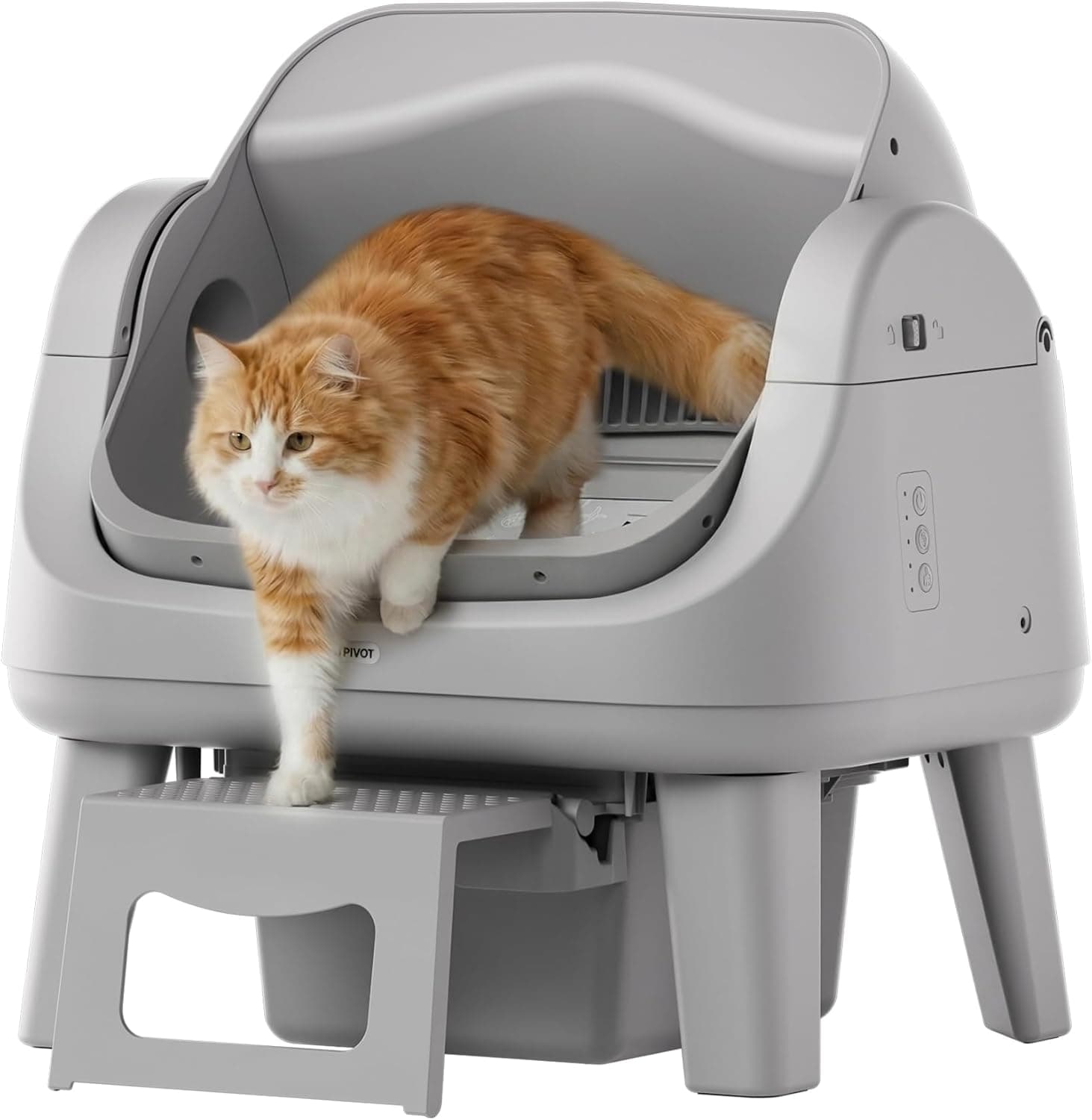 Best budget auto box
PetPivot AutoScooper 11
Open-top self-cleaning box with automatic raking and app control, at a budget price
Our verdict
The PetPivot AutoScooper 11 is the honest budget pick in automatic litter boxes: it delivers the core promise — no daily scooping — at a fraction of the premium tier's price, with an open-top design that enclosure-refusing cats actually accept. The trade-offs are real: a less refined rake, smaller waste capacity, a simpler app, and a shorter track record. Buy it for one or two cats on a budget; skip it where capacity, sensor depth, or decade-long reliability is the requirement. Use clumping clay, supervise the first week, and confirm the weight minimum.
How we researched this review
Same honesty as every review on this site: we did not test this unit in a lab, and we won't pretend we did. This PetPivot AutoScooper 11 review is a research-based assessment built from three sources:
- Manufacturer documentation — PetPivot's published specifications, safety information, app feature descriptions, and usage directions. Where the manufacturer documents something, we describe it as documented — not as verified.
- Retailer specifications — dimensions, capacity, warranty terms, and what's included in the box from major pet retailers.
- Themes from verified buyer reviews — recurring patterns across customer reports, weighted toward long-term ownership over first-week impressions. We note where buyer experience splits.
No invented ratings, no fabricated test anecdotes, and no exact pricing — we describe price only in tiers (budget vs. premium), because prices move and a review shouldn't pretend otherwise.
Sources
- PetPivot — AutoScooper 11 (official) — manufacturer's specs: rake mechanism, safety sensors, dimensions and capacity
Frequently asked questions
Part of our Best Automatic Litter Box hub — start there for the full overview.
Keep reading
Affiliate disclosure: The Litter Logic earns a commission when you buy through links on this page — at no extra cost to you. It keeps our guides free and independent. As an Amazon Associate I earn from qualifying purchases. Read our full disclosure.