
Litter-Robot 4 Review: Worth It? (2026)
Litter-Robot 4 review (2026): the self-cleaning cycle, litter compatibility, safety sensors, app features, and real buyer complaints, plus who should skip it.
Quick answer
The Litter-Robot 4 is the best-known self-cleaning litter box for a reason: a rotating globe that sifts waste automatically after every use, genuinely eliminating daily scooping. It's a premium-tier purchase in the high hundreds, needs clumping clay litter, and takes up real floor space. Transformative for multi-cat homes and frequent travelers; a luxury for a single cat with an owner who doesn't mind scooping.
Product overview: what the Litter-Robot 4 actually is
The Litter-Robot 4 is made by Whisker (formerly AutoPets), the company that invented the category. It's the fourth generation of their self-cleaning litter box, and the core idea is unchanged since the original: instead of you scooping, a motorized globe does it.
The unit is a large, roughly spherical chamber — about two feet in each dimension — sitting on a base that contains the waste drawer. Your cat enters through a wide opening, does its business on a bed of clumping litter inside the globe, and leaves. After an adjustable wait timer, the globe rotates: a patented sifting screen separates the clumps from the clean litter, drops the waste into a lined drawer below, and returns the clean litter to the starting position. You empty the drawer every several days to about a week (single cat) instead of scooping daily.
In the box: the unit, power supply, starter waste-drawer liners, and a starter bag of litter. Setup is simple — fill to the line, plug in, optionally connect the app. More on the company in our Whisker brand guide.
How the self-cleaning cycle works (in detail)
The cycle has four stages, and understanding them explains both the magic and the failure modes:
- Detection. Weight sensors in the base detect when a cat enters and exits. The unit will not start a cycle while a cat is inside — this is the primary safety interlock, and it's redundant with the anti-pinch design of the globe itself.
- Wait timer. After the cat exits, the unit waits. The delay is adjustable in the app (a few minutes at the short end), which matters because starting too soon interrupts clump formation — wet clumps break apart in the sifter and fall back as dirty litter. Longer waits give firmer clumps, especially in humid climates.
- Rotation and sifting. The globe rotates slowly. Clean litter falls through the sifting screen back into the globe; clumps are too large to pass and get carried up and over into the waste chute, dropping into the drawer below. The whole rotation takes a couple of minutes.
- Reset. The globe rotates back to the home position, leveling the clean litter bed. The unit is ready for the next visit.
What this means in practice: the box is effectively always clean. Odor drops dramatically — not from deodorizer, but because waste leaves the litter bed within minutes instead of sitting until your next scoop. That always-fresh effect is the biggest quality-of-life gain owners report.
The failure mode to know about: the cycle depends on clumps being firm enough to survive the sifter. Soft clumps (wrong litter, too-short wait timer, very humid environment) break apart, and the sifter then returns dirty fragments to the clean bed. Most "my Litter-Robot smells" complaints trace back to this, not to the machine.
Litter compatibility: clumping clay or nothing
This is the section that saves people from an expensive mistake: the Litter-Robot 4 is designed for standard clumping clay litter, full stop.
The sifting screen is calibrated for the granule size and clump behavior of clay. Non-clumping clay, crystal litter, pine pellets, paper litter, and walnut shells do not work with the cycle — they either fall through the screen wrong, don't clump at all, or jam the mechanism. Lightweight litters are also problematic: they're dusty in the enclosed globe and can confuse the weight sensors.
Practical guidance from buyer experience:
- Use a standard-grain clumping clay, unscented or lightly scented. Premium hard-clumping formulas perform best because firm clumps survive the sifter.
- Keep it at the fill line. Overfilling spills litter into the drawer during rotation; underfilling gives too shallow a bed for good clumps.
- Avoid "lightweight" formulas. They're the most common cause of cycle errors and excess dust in owner reports.
- Top up regularly. The level drops as clumps are removed — check it each time you empty the drawer.
If your heart is set on a natural litter, an automatic box probably isn't your product category — the mechanism and the material are a package deal.
Capacity and multi-cat suitability
The waste drawer is large — a single cat typically means emptying every several days to about a week; two cats cut that roughly in half. The globe fits most adult cats, though the largest breeds can find the entry snug.
For multi-cat homes, the Litter-Robot 4 is one of the strongest options in the category, and it's a fixture in our best automatic litter boxes for multiple cats for three reasons:
- Continuous cleaning. In a two- or three-cat home, a manual box degrades fast between scoops. The automatic cycle means cat #3 finds a clean box, which measurably reduces out-of-box incidents.
- Per-cat tracking. The smart scale weighs the cat on each visit, so the app can distinguish cats by weight and show you who's using the box how often — genuinely useful health signal in multi-cat homes where you can't otherwise tell whose output is whose.
- Drawer capacity. The drawer handles multi-cat volume better than smaller automatic boxes, though you'll be buying liners more often.
The honest limit: four or more cats on one unit is too many. Buyer reports are consistent — at that volume, the drawer fills too fast, the cycle runs near-constantly, and you're maintaining the machine more than it's saving you. The right answer at 4+ cats is two units or one unit plus a manual box, which changes the value math considerably.
Safety sensors and the kitten question
Safety is the #1 concern prospective buyers raise, and Whisker has layered the answer:
- Cat-sensor weight detection pauses everything while a cat is inside the globe. The cycle cannot start with a cat present.
- Anti-pinch design means the rotating globe doesn't create trapping points.
- Automatic night light and the open entry design mean cats aren't walking into a dark enclosed space blind.
The kitten caveat: Whisker documents a minimum cat weight for automatic mode — below it, the sensors may not reliably detect the cat. Young kittens should use manual mode (you trigger cycles yourself) until they're big enough; check Whisker's current published minimum before buying.
For adult cats, the safety record across the product line's long history is strong — this is a mature fourth-generation product, not a crowdfunded experiment.
The Whisker app: genuinely useful or gimmick?
The app (iOS and Android, WiFi-connected) is better than the "smart" label usually implies:
- Waste drawer level — the headline feature. You get a notification when the drawer is getting full instead of discovering it by smell.
- Usage history per cat — visit frequency and weight trends, which is a real early-warning system for urinary issues. Multiple owners report catching vet-worthy changes from the data.
- Cycle controls — adjust the wait timer, trigger manual cycles, put the unit to sleep on a schedule (useful if the box is near a bedroom — the cycle is audible).
- Litter level reminders and firmware updates.
App complaints are the usual smart-home ones: occasional connectivity drops and the need for a stable 2.4 GHz WiFi signal. Nothing category-breaking, but don't put the unit three rooms from your router.
What verified buyers consistently praise — and complain about
The praise, in order of frequency:
- No more daily scooping. This dominates every review corpus. Owners describe it as the rare product that fully delivers its core promise.
- Odor reduction. The always-clean litter bed cuts household litter smell dramatically — the second most common theme, especially from apartment owners.
- Multi-cat peace. The per-cat usage tracking and continuous cleaning resolve the two biggest multi-cat box problems at once.
- Travel freedom. Weekend trips without arranging a twice-daily scooper come up constantly.
The complaints, in order of frequency:
- The price. It's a premium-tier purchase in the high hundreds — the most common objection by far, and a fair one. This is an appliance-priced litter box.
- The footprint. It's roughly two feet in each dimension and needs clearance for the globe and drawer — measure before ordering, because returning something this bulky is a project.
- Ongoing liner costs. The waste drawer uses proprietary liners. They're not expensive individually, but they're a subscription-style recurring cost that manual-box owners never think about. (Some owners use standard trash bags as a workaround; fit varies.)
- The cycle is audible. It's not loud, but it's a mechanical rotation happening in your home — light sleepers put it on a sleep schedule via the app.
- Picky cats. A minority of cats refuse the globe — the enclosed shape, the movement, or the texture change. Whisker's transition guidance (treats, keeping the old box nearby, running it in manual mode at first) works for most, but not all. This is the risk you can't fully eliminate before buying.
- Maintenance isn't zero. You still empty the drawer, top up litter, wipe the globe periodically, and deep-clean every few months — roughly 15 minutes a week instead of 5 minutes a day.
Who should buy it — and who should skip it
- Genuinely eliminates daily scooping — the core promise holds up in long-term owner reports
- Always-clean litter bed cuts odor dramatically vs. manual boxes
- Excellent for multi-cat homes: capacity, continuous cleaning, and per-cat usage tracking
- Mature safety systems with redundant cat detection; strong track record across generations
- Useful app with drawer alerts and health-relevant usage data, not just a gimmick
- Premium-tier price in the high hundreds — an order of magnitude more than a manual setup
- Large footprint; measure your space and plan for drawer clearance
- Requires standard clumping clay — natural and alternative litters are incompatible
- Proprietary waste-drawer liners are a recurring cost
- A minority of cats refuse the globe; transition takes patience and isn't guaranteed
Buy it if: you have two or more cats, travel regularly, hate scooping enough to pay appliance prices to stop, or have limited mobility that makes daily scooping difficult.
Skip it if: you have one easygoing cat and don't mind a daily scoop — the payback period there is essentially never. Also skip if the home insists on natural litter, your cat is a known refuser of new setups, you have a tiny kitten, or the footprint won't fit. A great manual box plus good clumping litter gets you most of the odor benefit for a fraction of the price — see our best automatic litter boxes for the full landscape.
The alternative worth knowing: PetPivot AutoScooper 11
The Litter-Robot 4's most-cited rival is the PetPivot AutoScooper 11, which undercuts it on price while offering the same basic proposition — automatic raking/sifting after each use. The trade-offs in buyer reports: a smaller waste capacity, a less mature app ecosystem, and a shorter track record as a company. For budget-constrained buyers who want automation without the premium tier, it's the legitimate alternative — but "cheaper and newer" cuts both ways on reliability. We've broken down the head-to-head in our Litter-Robot 4 vs PetPivot AutoScooper 11 comparison.
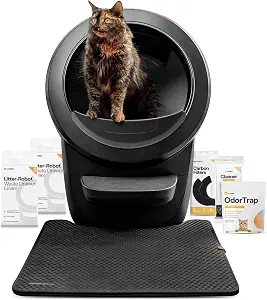 Best automatic overall
Litter-Robot 4
Self-cleaning globe with automatic sifting, safety sensors, and app monitoring
Our verdict
The Litter-Robot 4 is the best automatic litter box you can buy in 2026 — the cycle works, the safety systems are mature, and long-term owners overwhelmingly say they'd buy it again. But it's a premium-tier purchase in the high hundreds that demands clumping clay and real floor space. Buy it for multi-cat homes, travelers, and scoop-haters; skip it where a daily scoop doesn't bother you. Measure your space and confirm your cat meets the weight minimum before committing.
How we researched this review
We don't pretend to run a litter box lab. This Litter-Robot 4 review is a research-based assessment built from three sources:
- Manufacturer documentation — Whisker's published specifications, safety information, app feature descriptions, and usage directions.
- Retailer specifications — dimensions, capacity, warranty terms, and what's included in the box from major pet retailers.
- Themes from verified buyer reviews — recurring patterns across large numbers of customer reports, not cherry-picked quotes. We weighted long-term (6+ month) ownership reports over first-week impressions.
Where something is a manufacturer claim rather than independently verified, we say so. Where buyer experience splits, we say that too. No invented ratings, no fabricated test anecdotes, and no exact pricing — prices move, and a review shouldn't pretend otherwise.
Sources
- Whisker — Litter-Robot 4 (official) — manufacturer's specs: patented sifting cycle, sealed carbon-filtered waste drawer, Whisker app monitoring, 90-day home trial
Frequently asked questions
Part of our Best Automatic Litter Box hub — start there for the full overview.
Keep reading
Affiliate disclosure: The Litter Logic earns a commission when you buy through links on this page — at no extra cost to you. It keeps our guides free and independent. As an Amazon Associate I earn from qualifying purchases. Read our full disclosure.