Can You Flush Cat Litter?
Can you flush cat litter? What plumbers and wastewater guidance say about clumping, crystal, and biodegradable litter, and why most should stay out of toilets.
Quick answer
Can you flush cat litter? The short answer: only litters explicitly marketed as flushable — and even then, with limits. World's Best and sWheat Scoop both claim septic safety based on lab testing, but plumbers remain skeptical, and many municipalities discourage or prohibit flushing pet waste because of parasite concerns. Clumping clay, crystal, walnut, and pine pellets should never be flushed; they can cement in pipes. The safest move is always to bag it and trash it.
Why this guide separates three different questions
"Flushable" is one of the litter aisle's most loaded words, and most of the confusion comes from three different questions being mashed into one: will it break down? (sometimes), is it safe for my plumbing? (maybe), and is it allowed where I live? (check). This guide separates all three, because a yes to the first is not a yes to the other two. We did not test flushing litters in pipes, and we won't pretend we did. What's here comes from how different litter materials behave in water, documented plumber guidance on clogs, manufacturer flushability claims, and the published reasoning municipalities give for pet-waste rules.
What "flushable" on the bag actually means
When a litter brand calls itself flushable, the claim is narrow: the material breaks down in water rather than holding its shape. Corn, wheat, and some wood-fiber litters genuinely do this — they soften and disperse instead of sitting in the pipe like a rock.
But that claim says nothing about your pipes' age, your water pressure, your septic system, or your city's rules. A material that disperses in a lab beaker can still cause problems in a decades-old cast-iron lateral with low-flow fixtures. "Flushable" describes the litter, not your plumbing. Keep that distinction in mind for everything below — it's the key to the whole topic.
Which litters are marketed as flushable
The flushability claim belongs almost entirely to plant-based litters:
- Corn-based litters — the category leader. World's Best Cat Litter is the best-known flushable claim: the manufacturer says all its formulas are flushable and septic-safe, citing independent lab testing, and recommends a scoop at a time. Our World's Best cat litter review examines the claim in detail.
- Wheat-based litters — sWheat Scoop makes a similar flushable claim, also including septic safety.
- Some wood and paper litters — a few claim it; most don't.
And the never-flush list, which matters more than the claim list:
- Clumping clay — bentonite is designed to swell and bind in water. That's the clumping mechanism, and it works in drain pipes exactly the way it works in the box. Flushed clay can set like cement in your plumbing.
- Silica crystal — doesn't break down at all. Tiny glass-like beads that settle happily into pipe bends.
- Walnut shell — dense and doesn't disperse. Our walnut litter pros and cons guide covers why plant-based doesn't mean plumbing-safe.
- Pine pellets — compressed sawdust expands in water. In a pipe, that's a clog with ambition. See our wood pellet litter guide for how the sifting system is supposed to work instead.
For the full picture of how each material handles moisture, see our complete guide to the types of cat litter.
If flushability is the priority, the litter most associated with the claim is World's Best — but read the caveats in the sections below before you try it.
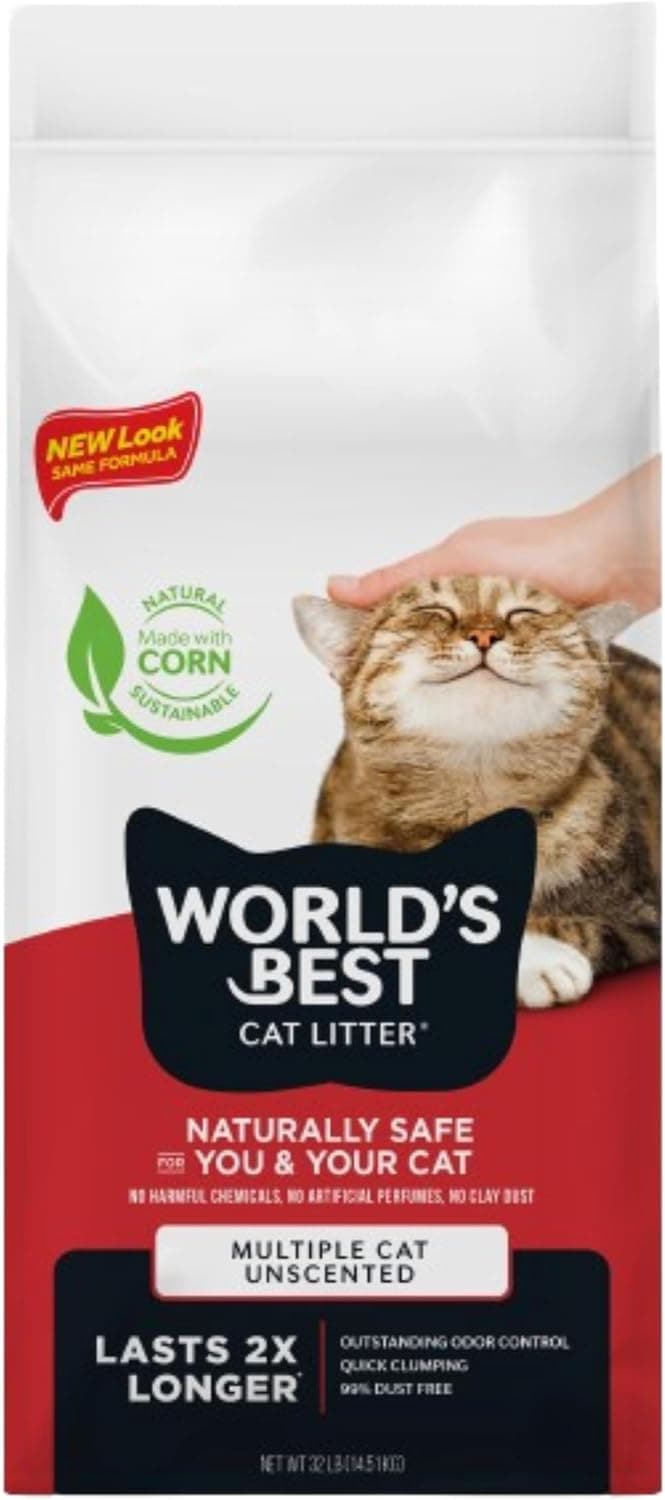 Flushable claim
World's Best Multi-Cat Clumping Cat Litter
Whole-kernel corn litter — the best-known flushable-claim formula (manufacturer claims septic-safe too)
Why plumbers generally say don't
Plumbers are nearly unanimous on this, and their reasoning is mechanical, not moral:
- Clumping litter is engineered to harden in water. Bentonite doesn't care whether the water is in a litter box or a drain pipe. Flushed clumps can bind into a mass that narrows or blocks the line — and unlike a hair clog, it can't easily be snaked out.
- Even "flushable" litter is a volume problem. The manufacturer guidance is a scoop at a time, with plenty of water and a full flush between additions. Most people don't do this — they dump the box. A large slug of even dispersible litter can overwhelm a toilet's trap and the line beyond it.
- Old plumbing is unforgiving. Cast-iron pipes develop rough interiors that catch debris; low-flow toilets move less water per flush; long horizontal runs give material time to settle. The newer the plumbing and the stronger the flush, the more margin you have — but most homes aren't new.
- Septic systems deserve extra caution. Septic tanks depend on bacterial balance and settling, and a failed drain field is a repair bill in the thousands. World's Best and sWheat Scoop both claim septic safety based on lab testing — but that testing covers the litter breaking down, not your specific system's age or condition. Most septic professionals advise keeping everything but human waste and toilet paper out.
The plumber's rule of thumb is simple: toilets are designed for human waste and toilet paper. Everything else is a gamble with your pipes.
The reason cities say don't: pet waste rules
Separate from plumbing, many municipalities discourage or prohibit flushing pet waste — and the reasoning is environmental, not mechanical. Cat waste can carry Toxoplasma gondii, a parasite whose hardy oocysts can survive some wastewater treatment processes and reach waterways. We're keeping this general on purpose: this is the published reasoning cities give for their rules, not a medical claim about your household.
The practical upshot: even if your litter is flushable and your plumbing is modern, your city may still say no. A quick check of your local municipal guidance settles it — and where the guidance is ambiguous, the conservative read is the right one.
What to do instead
The unglamorous, universally safe method:
- Scoop waste into a bag. Small dedicated waste bags, repurposed grocery bags, or biodegradable bags — whatever you'll actually use every day.
- Tie it off and put it in the trash. This is what most vets and waste authorities recommend. Double-bag on hot days if odor is a concern.
- Don't compost cat waste at home. Backyard compost doesn't reliably reach the temperatures needed to neutralize pathogens. Municipal green-waste programs generally don't accept pet waste either — check yours, but assume no.
It's less elegant than flushing, and it generates plastic. Those are real downsides. They're also much smaller downsides than a plumber's bill or a violated city ordinance.
If you're going to flush anyway: the ground rules
We'd rather give you the safe version than pretend nobody does it:
- Prefer sewer systems; be extra cautious with septic. Two manufacturers claim septic safety, but that claim covers the litter breaking down — not your pipes' age or condition. When in doubt, don't.
- Only litters explicitly labeled flushable. Corn and wheat formulas with a printed flushable claim — not walnut, not clay, not crystal, not pellets.
- A scoop at a time, with a full flush between. Never dump a box's worth.
- Check your local rules first. If your municipality prohibits flushing pet waste, the litter's claim doesn't override that.
- Watch for slow drains. The first sign of a developing clog is a toilet that drains sluggishly. Stop flushing litter immediately if you see it.
And on routine regardless of disposal method: daily scooping plus a full litter change on schedule is what actually keeps the box odor-free. Our guide to how often to change cat litter covers the timing by litter type.
Our verdict
Flushing cat litter is one of those ideas that's technically possible in a narrow set of conditions and practically inadvisable in most of them. If your litter is labeled flushable, your home is on a sewer system, and your municipality allows it, small amounts will probably be fine — but "probably fine" is doing a lot of work in that sentence. For everyone else: bag it and trash it. It's boring, it's safe, and it never calls a plumber.
Sources
- World's Best Cat Litter — Is It Flushable? — the manufacturer's flushability and septic-safety claim, citing independent lab testing (1–2 clumps at a time).
- UC Davis School of Veterinary Medicine — Toxoplasmosis & cat waste (PDF) — "don't flush kitty litter down the toilet — sewage treatment may not kill Toxo eggs"; bag waste and trash it.
- Sierra Club — Can I Flush Cat Poop? — why neither septic nor municipal systems are a safe bet for cat waste (Toxoplasma risk to waterways and wildlife).
Frequently asked questions
Part of our Types of Cat Litter: Complete Guide hub — start there for the full overview.
Keep reading
Affiliate disclosure: The Litter Logic earns a commission when you buy through links on this page — at no extra cost to you. It keeps our guides free and independent. As an Amazon Associate I earn from qualifying purchases. Read our full disclosure.