
Best Automatic Litter Box
Best automatic litter box of 2026: 5 self-cleaning boxes compared honestly — sifting tech, safety, app reliability, and multi-cat fit, research-based.
Quick answer
The best automatic litter box is the Litter-Robot 4 by Whisker — the most refined sifting mechanism on the market, real safety sensors, and an app that tracks usage, waste levels, and litter habits. If the price stings, the older Litter-Robot 3 Connect delivers most of the experience for less. For a fully enclosed unit, PETKIT Pura Max is the strongest alternative; for an open-top design, Neakasa M1 Plus; and for the budget end, PetPivot AutoScooper 11 covers the basics. Automatic boxes are a different purchase than litter — you're buying a machine, so mechanism, safety, and reliability outrank brand loyalty.
Why automatic boxes are a different buying decision
A bag of litter is a $20 experiment you can abandon. An automatic litter box is a $300–$700 appliance that lives in your home for years — closer to a dishwasher than a bag of clay. The decision criteria change accordingly:
- Mechanism reliability matters more than marketing. Every brand promises "hands-free cleaning." The difference is in how the sifting, raking, or rotation mechanism holds up over months of daily cycles.
- Safety is non-negotiable. A machine that moves while your cat is inside is a hazard. Modern units carry detection sensors that pause cleaning when a cat enters — we treat the absence of documented safety sensing as a disqualifier.
- Litter compatibility is a hard constraint. Most automatic boxes work with clumping litter only. Crystal, non-clumping clay, and lightweight alternatives jam sifting mechanisms or fall through grates.
- Multi-cat capacity is about the waste bin, not the box. Two cats don't need a bigger globe — they need a bigger drawer and a unit rated for the waste volume.
Because these are machines, app reliability matters too: connectivity drops, false "bin full" readings, and flaky usage tracking are the most common buyer complaints across every brand here.
The 5 best automatic litter boxes at a glance
| Criteria | Litter-Robot 4Pick | Litter-Robot 3 Connect | PETKIT Pura Max | Neakasa M1 Plus | PetPivot AutoScooper 11 |
|---|---|---|---|---|---|
| Cleaning mechanism | Rotating globe sifting | Rotating globe sifting | Enclosed sifting + sealed bag | Sifting with pull-out bin | Automatic raking |
| Box style | Semi-enclosed globe | Semi-enclosed globe | Fully enclosed | Open-top | Open-top |
| App control | Whisker app (usage insights) | Whisker app | PETKIT app (multi-cat tracking) | App control | App control |
| Multi-cat fit | Designed for multi-cat homes | Suits two-cat homes | Multi-cat tracking profiles | Large capacity | Large capacity |
| Litter requirement | Clumping litter | Clumping litter | Clumping litter types | Clumping litter | Clumping litter |
| Safety approach | OmniSense detection system | Cat detection sensors | Infrared safety sensors | Sensors + auto-pause | Safety sensors |
1. Litter-Robot 4 by Whisker — Best overall
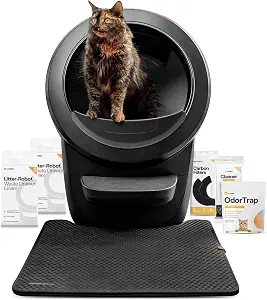 Best overall
Litter-Robot 4 by Whisker
QuietSift automatic sifting with the Whisker app and OmniSense detection
- Most refined sifting mechanism in the category — globe rotation is proven tech
- OmniSense detection system pauses cycles when a cat is present
- Whisker app tracks usage, waste levels, and litter habits genuinely well
- Designed for multi-cat homes with a large waste drawer
- QuietSift system runs noticeably quieter than earlier generations
- Premium price — the most expensive box on this list
- Still requires clumping litter; no crystal or non-clumping
- Large footprint — measure your space before buying
- App pairing can be finicky on some home networks
Why it wins: the Litter-Robot 4 is the category's reference point for a reason. The rotating-globe mechanism is mature — after the cat exits and a delay passes, the globe turns, sifted clean litter falls through a screen back into the bed, and waste drops into a sealed drawer with a carbon filter. OmniSense detection watches for the cat's presence and pauses the cycle, which is the safety standard everything else is judged against. The app is the best in the category: usage tracking per cat (with multi-cat homes in mind), waste-drawer alerts, and litter-level monitoring. Buyer complaints cluster where you'd expect for any smart appliance — Wi-Fi pairing gripes and the premium price — not the mechanism. For the deep dive, read our Litter-Robot 4 review and the Whisker brand page.
2. Litter-Robot 3 Connect — Best value
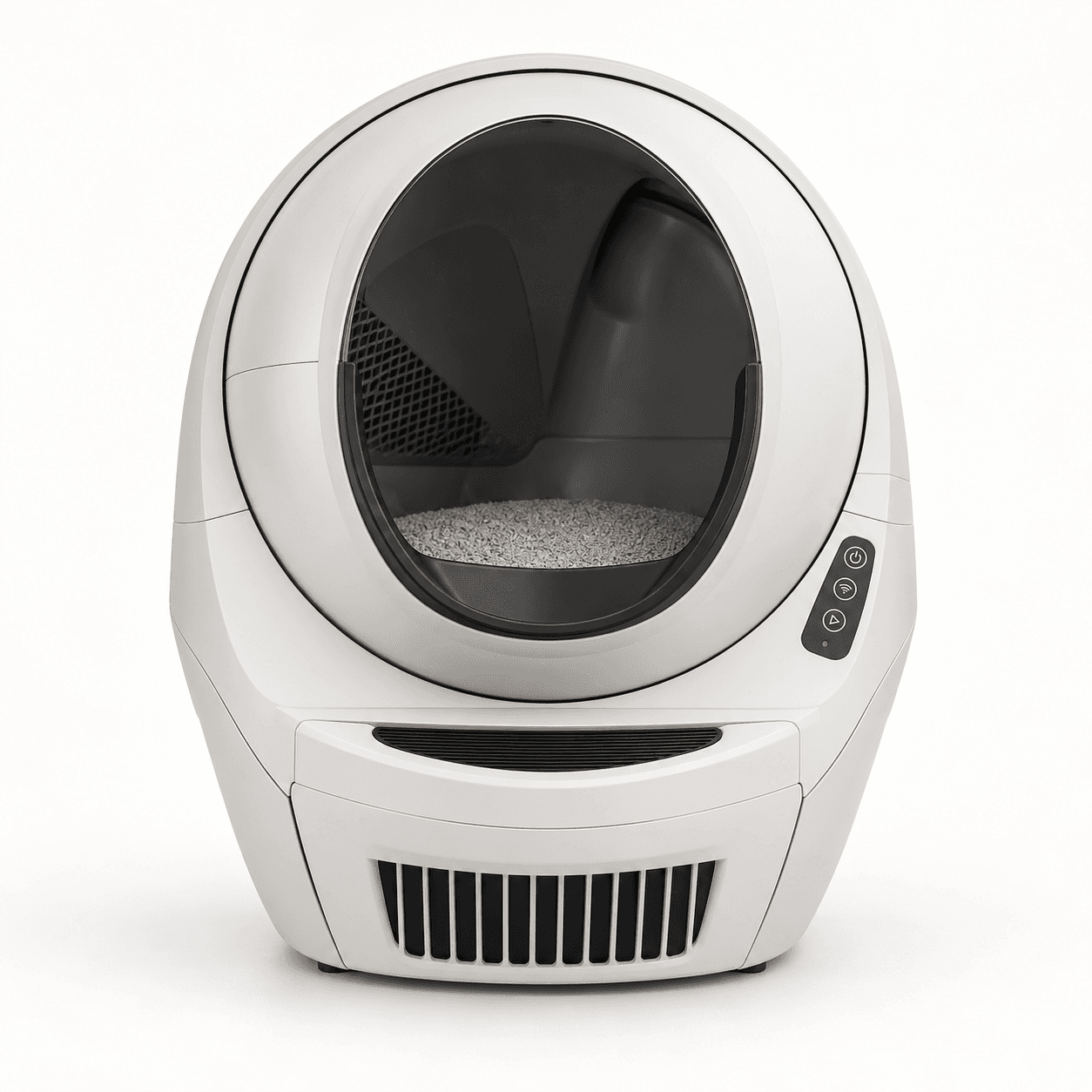 Best value
Litter-Robot 3 Connect
The previous-generation globe with app connectivity, at a lower price
- Same proven globe-sifting mechanism as the line is known for
- Whisker app with status, notifications, and drawer-full alerts
- Typically costs meaningfully less than the Litter-Robot 4
- Huge owner community — troubleshooting help is easy to find
- Louder cleaning cycles than the newer generation
- Safety sensors are a generation behind the LR4's OmniSense
- Older design — expect fewer firmware updates going forward
Why it's here: the Litter-Robot 3 Connect is the smart way to buy into the ecosystem without the flagship price. The globe-sifting mechanism is the same proven design, the Whisker app (formerly Litter-Robot Connect) covers the essentials (status, notifications, drawer-full indicator), and cat detection sensors are documented. You give up the LR4's quieter cycles, the newer sensor system, and the more detailed app insights — but the core experience, a box that cleans itself reliably, is intact. For two-cat homes that don't need the newest sensors, it's the rational pick.
3. PETKIT Pura Max — Best fully enclosed
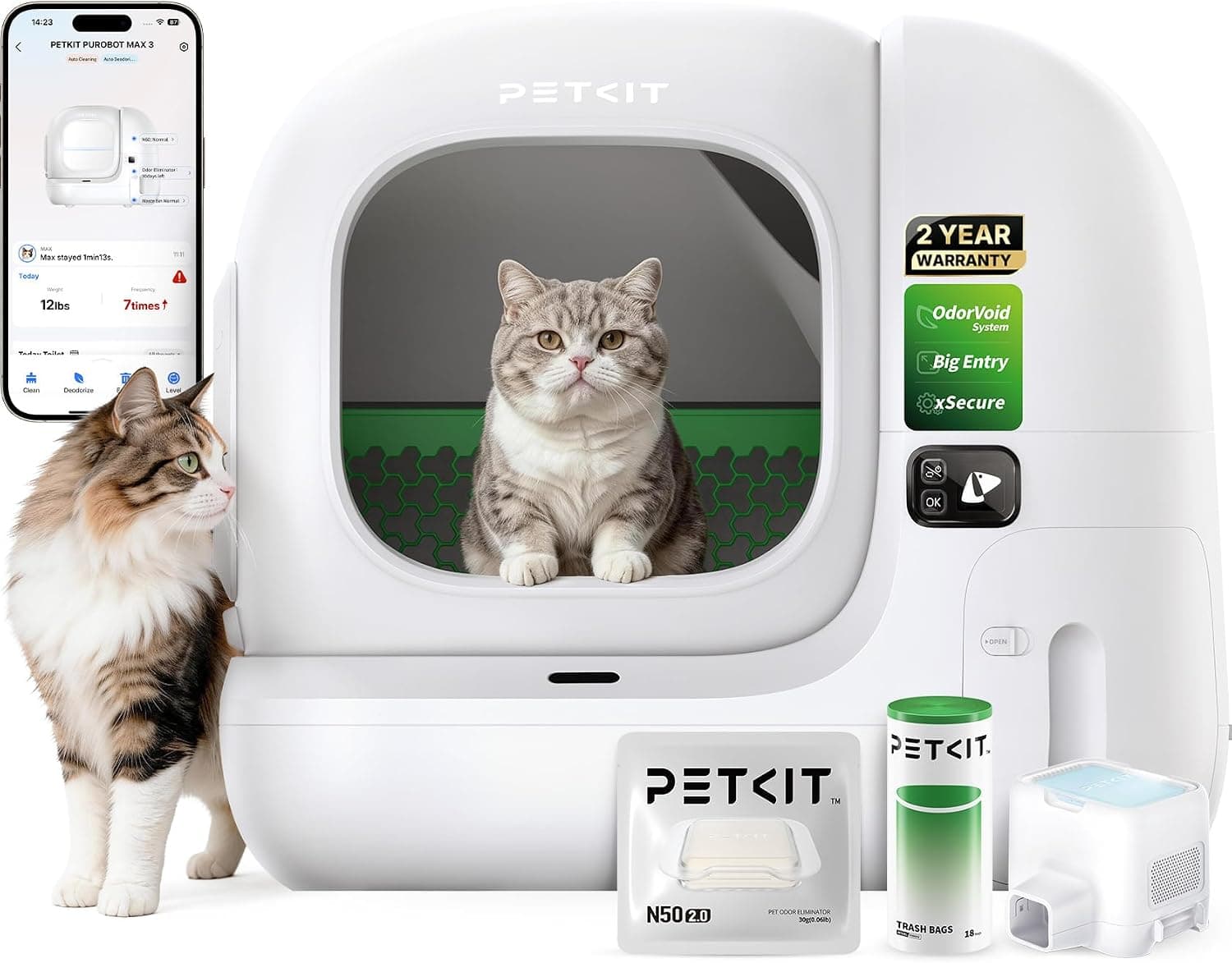 Best enclosed
- Fully enclosed design — best odor containment of any pick here
- Automatic waste sealing into a closed bag system
- PETKIT app supports multi-cat profiles and usage tracking
- Infrared safety sensors documented by the manufacturer
- Premium pricing close to flagship territory
- Enclosed style needs cat buy-in — some cats refuse covered boxes
- Replacement waste bags are an ongoing cost
- Larger cats may find the entry tight
Why it's here: if odor containment is the priority — apartment, studio, box near the living space — the fully enclosed Pura Max is the strongest option. The unit sifts waste automatically and seals it into a closed bag, so odor never sits in an open drawer. Infrared sensors guard the cleaning cycle, and the PETKIT app handles multi-cat profiles with per-cat usage data. The trade-off is philosophical as much as practical: some cats refuse enclosed boxes entirely, and you should confirm yours accepts a covered box before committing to the premium price. It's also the pick with the clearest ongoing cost (the sealed bags), so factor that in.
4. Neakasa M1 Plus — Best open-top design
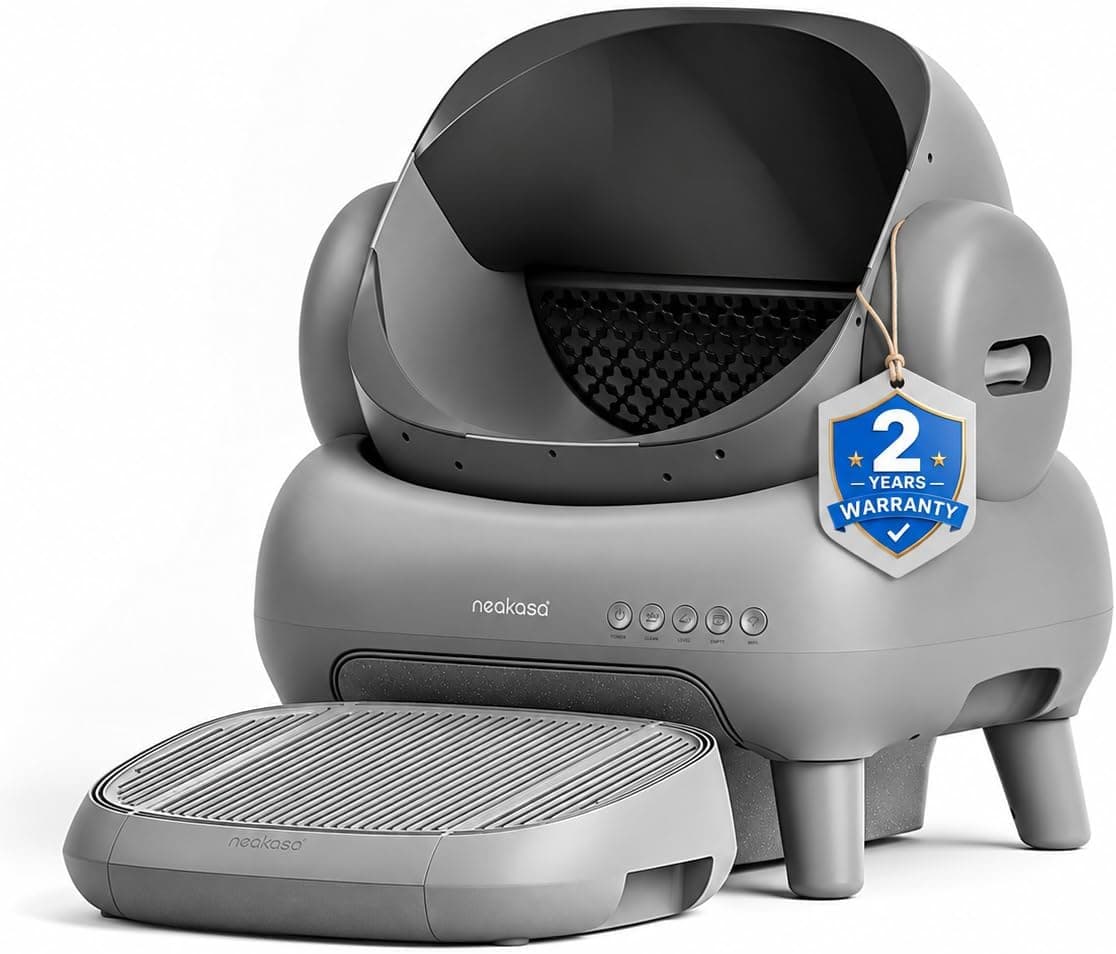 Best open-top
Neakasa M1 Plus
Open-top self-cleaning litter box with app control and pull-out waste bin
- Open-top design — cats that reject enclosed boxes accept it more readily
- Large entry suits bigger cats
- App control with cleaning scheduling
- Pull-out waste bin is simple to empty
- Open top means less odor containment than enclosed units
- Newer brand in this category — shorter track record
- Sensor system is simpler than the flagship's multi-sensor array
Why it's here: the M1 answers the most common reason automatic boxes get returned: the cat won't go in. Its open-top design removes the enclosure objection entirely, and the large entry accommodates bigger cats that find globe openings tight. The cleaning cycle is automatic with app scheduling, sensors pause it when the cat is present, and the pull-out waste bin keeps emptying simple. You trade odor containment — an open top is an open top — so this is the pick for a ventilated laundry room or basement, not a studio apartment. For buyers whose cat has already rejected a covered box, it's the best-designed alternative.
5. PetPivot AutoScooper 11 — Best budget pick
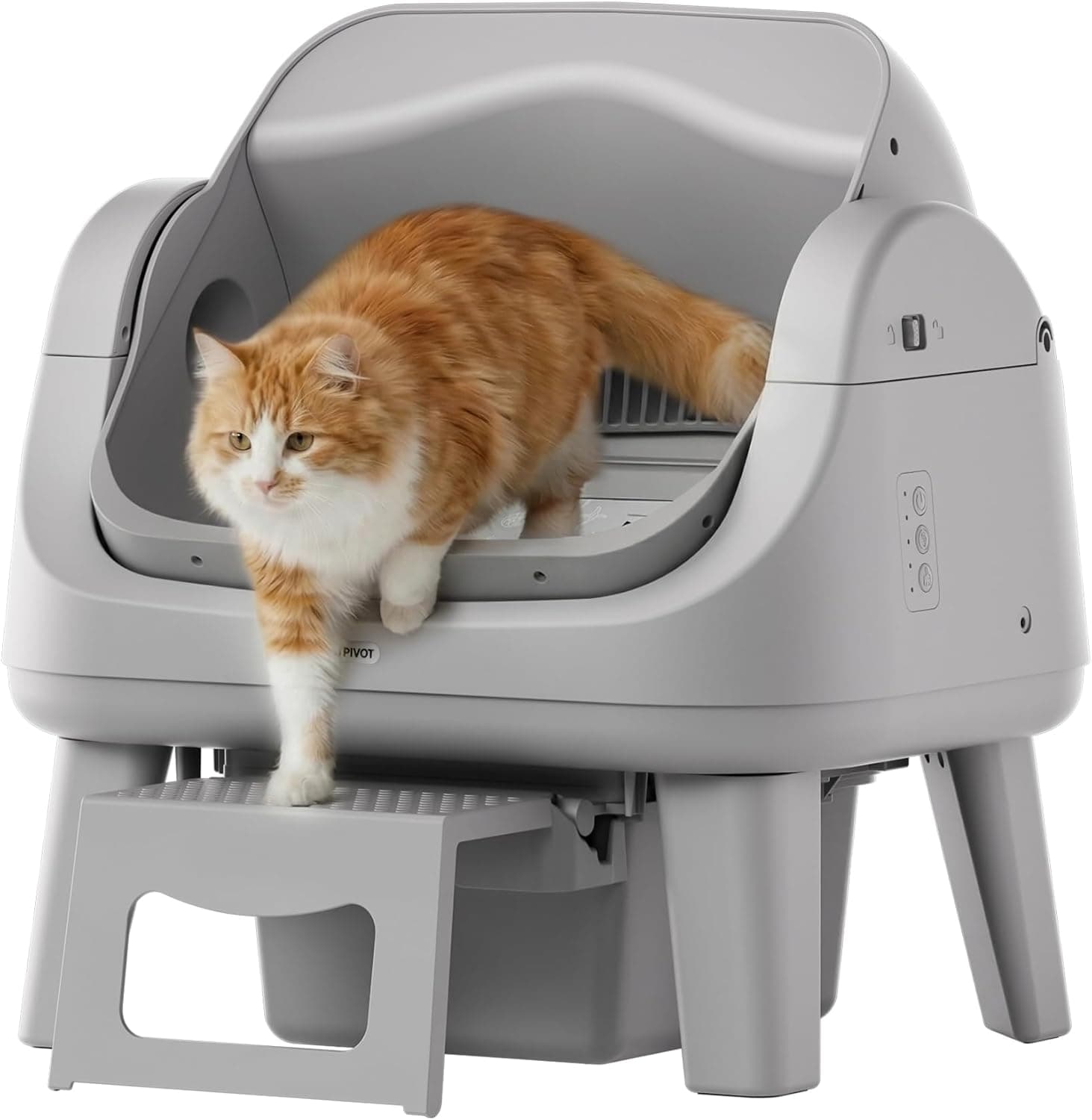 Best budget
PetPivot AutoScooper 11
Automatic raking self-cleaning box with app control at a budget price
- Lowest price of any automatic box on this list by a wide margin
- Automatic raking covers the basics — no daily scooping
- Large capacity suits the price point
- App control included, which budget boxes often skip
- Raking mechanism is less refined than globe sifting — expect occasional misses
- Safety sensor system is basic vs. the flagships
- Build quality reflects the price; treat it gently
- Buyer reports on long-term reliability are thinner than for established brands
Why it's here: the AutoScooper 11 exists for one buyer: someone who wants to stop scooping but can't justify flagship money. The automatic rake clears the box on a cycle, the capacity is generous for the price, and app control is genuinely included. The honest trade-offs are mechanism refinement and track record — raking misses clumps that globe sifting catches, and PetPivot doesn't have Whisker's decade of iteration. Buy it for the convenience upgrade at a price you can absorb, not as a lifetime appliance. And as with every box here, supervise the first week and confirm your cat meets the manufacturer's minimum weight.
What litter to use in an automatic box
This deserves its own section because it's the #1 reason automatic boxes underperform: wrong litter. Every pick above needs clumping litter — the mechanism separates clumps from clean litter, and non-clumping formulas have nothing to grab. Silica crystal doesn't clump either, and lightweight litters can fall through sifting screens or jam rakes.
Within clumping litters, the best performers are medium-grain formulas with hard, fast clumps and low dust — dust coats sensors and mechanisms over time. Our dedicated guide to the best litter for automatic litter boxes ranks formulas specifically on sift-cleanliness and low jamming. Clumping litter also tracks on paws, so a litter mat at the exit is worth adding. If you're running multiple cats through a robot box, pair it with our multi-cat self-cleaning guide for capacity-first advice.
How to transition your cat to an automatic box
Most automatic-box returns happen in week one, and they're almost always a transition failure rather than a product failure. The pattern that works, per buyer reports and published vet behavior guidance:
- Set it up powered off. Let the box sit where the old box was, unplugged, for a few days. The cat investigates a new object without the scary part.
- Mix old litter in. Fill it with a blend of the old litter and fresh clumping litter so it smells familiar.
- Run cycles manually at first. Trigger a cleaning cycle while the cat is in another room, so it learns the sound without being startled mid-use.
- Keep the old box available. Don't remove it until the cat uses the new box reliably for several days — then retire the old one.
- Don't rush timid cats or kittens. Anxious cats may need two weeks. That's normal, and far better than a cat that starts avoiding boxes entirely.
The honest fine print on automatic boxes
Before you buy any of these, four realities worth knowing:
- There's a transition period. Most cats need days to weeks to accept a box that moves and hums. Run it in manual/semi-auto mode first, keep the old box available, and don't force it — a cat that avoids the box is a bigger problem than scooping ever was.
- You still empty a bin. "Self-cleaning" means no daily scooping, not no maintenance. Single-cat homes empty the waste drawer weekly; multi-cat homes, every few days. The sealed-bag systems just make it less unpleasant.
- Minimum weight requirements are real. Every manufacturer publishes one. Kittens and very small cats shouldn't use an automatic box until they meet it — check the manual, not a review.
- Power and placement matter. These need an outlet and a level surface, and they hum. Don't put one against a bedroom wall if you're a light sleeper.
Our verdict
Buy the Litter-Robot 4 by Whisker for the best automatic litter box experience — the mechanism, safety system, and app are the category standard. Take the Litter-Robot 3 Connect to get most of that for less. Choose PETKIT Pura Max for maximum odor containment, Neakasa M1 Plus if your cat rejects enclosed boxes, and PetPivot AutoScooper 11 for the budget route. Whichever you pick, use clumping litter and supervise the first week.
How we ranked these
We did not test these in a lab, and we don't claim we did. Rankings are research-based: documented product specifications and safety systems from the manufacturers, the cleaning mechanism each unit uses (rotation, raking, or sifting), litter compatibility as documented by the brand, capacity claims for multi-cat homes, and recurring themes from large volumes of verified buyer reviews — with special attention to what breaks, what the app does wrong, and what the safety sensors actually do.
We weighted:
- Cleaning mechanism and reliability (35%) — how the unit separates waste, and what buyers report about jams, misses, and mechanical wear.
- Safety system (25%) — documented detection sensors that pause the cycle when a cat is present. Any unit without a documented sensor system was excluded.
- Multi-cat capacity (20%) — waste-bin size and manufacturer multi-cat ratings.
- App and smart features (10%) — usage tracking, waste-level alerts, and connectivity reliability as reported by buyers.
- Value (10%) — what you get per dollar, acknowledging this is a premium category.
We never invented specs, dimensions, or prices. Where a manufacturer documents a feature, we describe the feature. Where buyer experience splits, we say so.
Sources
- 2021 AAHA/AAFP Feline Life Stage Guidelines — peer-reviewed veterinary guidance: automatic-box acclimation advice and why unscented litter matters for box acceptance.
Frequently asked questions
Related reading
Compare the flagship and budget options in our PetPivot AutoScooper 11 review.
In this guide
Keep reading
Affiliate disclosure: The Litter Logic earns a commission when you buy through links on this page — at no extra cost to you. It keeps our guides free and independent. As an Amazon Associate I earn from qualifying purchases. Read our full disclosure.