
PrettyLitter Review: Worth It? (2026)
Our PrettyLitter review examines the silica crystal health-monitoring litter: how color changes work, what they mean, and who the subscription suits.
Quick answer
PrettyLitter is a silica crystal litter that absorbs urine into the granules instead of clumping, with a genuine twist: pH-sensitive crystals change color to flag possible urinary health issues early. The odor control and near-zero dust are real, but so are the caveats — it costs more than conventional litter, the crystal texture is the most commonly rejected of any litter type, and the color change is an early indicator, not a diagnosis. It's worth it for owners who want urinary-health visibility; it's not the budget pick. For more on the brand, see our PrettyLitter brand guide.
Product overview: what's actually in the bag
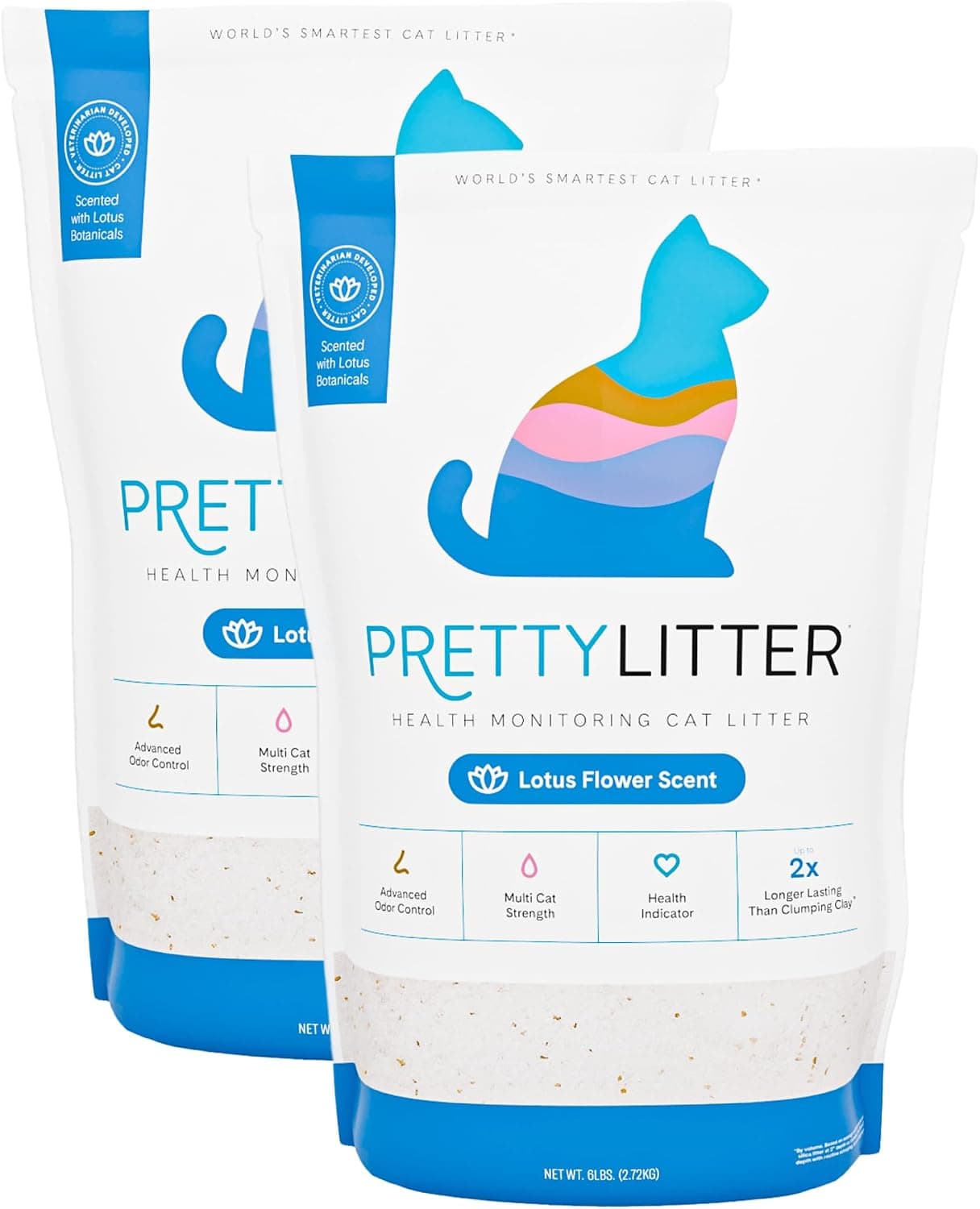
PrettyLitter is a non-clumping silica crystal litter — small, porous granules of silica gel, the same family of material used in desiccant packets (non-toxic in this form). The mechanism is absorption, not clumping: urine soaks into the crystals, which trap the liquid and odor inside the granule while the moisture gradually evaporates. That means there are no clumps to scoop and no heavy bags of saturated clay to haul — you scoop solids only, stir the crystals daily, and replace the whole box on a cycle.
Practical details from the manufacturer:
- Sold primarily by subscription, sized by cat count — one bag per cat per month. Single bags are also available as a one-time purchase if you want to trial it first, and the company says subscriptions can be paused or canceled anytime.
- Lightweight. A bag of crystals weighs a fraction of the equivalent clay, which is a genuine quality-of-life difference if you carry litter up stairs.
- Unscented and documented as very low-dust. Silica crystals don't crumble the way clay does, so airborne dust is minimal.
- Multi-cat bundles exist for households with more than one cat — each cat still needs its own bag per the model.
The headline feature, of course, is the color change. Let's examine that honestly, because it's the entire reason this litter costs more than clay.
The color-change health monitoring, examined
The crystals carry pH indicators that react to the acidity or alkalinity of your cat's urine, plus a reaction to the presence of blood. After your cat urinates, the crystals in that spot change color. Here's the manufacturer's own color guide:
- Dark yellow / olive green — typical. Urine within the normal, healthy pH range. This is what you'll see most days.
- Orange — acidic. May indicate acidity outside the average range; the manufacturer links this to possible metabolic acidosis or kidney tubular acidosis, noting calcium oxalate crystals can be more likely to form in acidic urine.
- Blue / dark green — alkaline. May indicate alkalinity outside the average range, which the manufacturer associates with certain urinary tract infections and higher risk of struvite crystal or stone formation.
- Red — blood. The presence of blood, which may indicate feline lower urinary tract disorder, bladder stones or crystals, inflammation, kidney issues, or other problems.
What this actually is: an early indicator. Urinary problems in cats — especially UTIs and blockages in males — escalate from "mildly uncomfortable" to "life-threatening" fast, and cats are experts at hiding discomfort. A color change in the litter can surface a problem days before behavioral symptoms appear. That's genuinely valuable, particularly for senior cats and breeds prone to urinary issues.
What this is not: a diagnosis. PrettyLitter's own materials say the litter was designed to give insight into urinary health but that only a veterinarian can diagnose a medical problem. Diet, medications, and even stress can shift urine pH, so a blue patch doesn't automatically mean a UTI — and normal-colored litter doesn't guarantee health. Treat any worrying color as a prompt to call your vet, not as an answer.
Two more honest notes: the manufacturer notes that the crystals naturally drift toward a soft golden tone over weeks of use as they absorb ambient moisture — that's normal saturation, not a health signal, and it's your cue the change cycle is approaching. And in a multi-cat home, one box of crystals can't tell you which cat produced the color. For per-cat tracking you'd need separate boxes or a different system.
Odor control, dust, and tracking
Odor control is strong, with a mechanism that's easy to respect: instead of masking urine smell with fragrance, the silica traps the liquid inside the granule where bacteria can't easily reach it. Buyer reports are consistently positive here — urine odor is the category PrettyLitter handles best. Solid waste still needs daily scooping; crystals do nothing for stool odor until you remove it.
Dust is among the lowest of any litter type. Silica gel crystals don't break down into fine particles the way clay does, and the manufacturer documents the formula as low-dust. If anyone in the house has litter-dust allergies or asthma, this is one of the safest textures available. For a deeper look at the material itself, read our crystal litter safety guide.
Tracking is low-moderate. The crystals are small and light, so some do hitchhike on paws — but they don't stick the way fine clay does, and a basic litter mat catches most of them. The bigger tracking complaint in buyer reviews isn't the crystals leaving the box, it's the crystals being everywhere when a cat kicks enthusiastically — a behavior issue more than a product one.
Who it's for — and who should skip it
- Color-change monitoring can flag urinary issues before symptoms appear — the real reason to buy
- Excellent urine odor control from genuine absorption, not fragrance
- Very low dust and lightweight bags
- No clumps to break apart; monthly routine suits busy schedules
- Subscription can be paused or canceled, and single bags are available to trial
- Premium pricing vs. conventional clay — you pay for the monitoring
- Crystal texture is the most commonly rejected litter type; some cats refuse it
- Color change is an indicator, not a diagnosis — it doesn't replace vet care
- One box can't identify which cat produced a color change in multi-cat homes
- Non-clumping routine (scoop solids, stir, replace) takes getting used to
Buy it if: you want early warning on urinary health — senior cats, cats with a history of UTIs or crystals, or owners who'd sleep better with a daily visual check. It also suits dust-sensitive households and anyone who hates hauling heavy clay bags.
Skip it if: your cat has rejected new textures before (crystal is the hardest sell in the category), you're on a tight litter budget, or you need per-cat health data in a multi-cat home. And if what you actually want is maximum odor control at minimum cost, our odor-control roundup has stronger value picks.
Common complaints: what buyers actually grumble about
No litter is complaint-free, and PrettyLitter's recurring gripes are worth knowing before you subscribe:
- The cost. This is the #1 complaint by volume. PrettyLitter costs substantially more per month than conventional clay, and the premium is entirely for the health monitoring. Buyers who love the product accept the trade; buyers who expected a budget litter feel stung. Know which camp you're in before the first delivery.
- Texture rejection. The second-most common complaint: the cat won't use it. Crystal granules feel nothing like clay or sand under paws, and some cats — especially older cats set in their ways — refuse outright. This is a product-category reality, not a defect, but it's the reason the transition guidance below matters.
- Multi-cat saturation. One bag per cat per month is the model, and buyers who stretch one bag across two cats report the odor control falling off well before the month ends. In multi-cat homes the per-cat math is non-negotiable.
- Color-change anxiety. A blue or orange patch sends some owners into a panic that turns out to be diet-related or transient. The monitoring is a feature, but it's also a new thing to worry about — worth knowing if you're an anxious pet parent.
- Not flushable, not compostable. Used silica goes in the trash. Buyers expecting an eco-friendly disposal story are disappointed; this is a landfill product like most litters.
The transition: getting your cat to accept crystals
This is the section that determines whether PrettyLitter works for you, because the most common failure mode isn't the product — it's the cat refusing to step on it. PrettyLitter's own documented transition method:
- Don't swap cold turkey. Fill the box with roughly 75% PrettyLitter and pour a 25% layer of your cat's current litter on top, so the surface texture stays familiar.
- Keep the old box available. Run the new box alongside the old one for at least a week. Let the cat choose; a cat with no alternative may simply hold it or go elsewhere in the house.
- Move to 100% crystals next cycle. Once the cat is using the mixed box reliably, the next fresh fill can be all PrettyLitter.
Watch the box, not the calendar. If after a week or two the cat is avoiding the new box, the texture isn't going to grow on them — crystal rejection is usually decisive, not gradual. A cat avoiding the box is a far worse outcome than any litter benefit, so don't force it.
Getting the most out of it: the routine that makes it work
PrettyLitter's maintenance is different from clay, and most buyer disappointment traces back to treating it like clay:
- Scoop solids daily. Crystals absorb urine; they do nothing for stool. Daily solid removal is non-negotiable.
- Stir gently every day. Mixing brings saturated crystals to the surface where moisture can evaporate and buries fresher crystals below. The manufacturer specifically recommends stirring the bottom litter up with the top.
- Maintain 3+ inches of depth. Shallow crystals saturate fast and lose both odor control and color accuracy. Top up as needed.
- Keep the box out of humid rooms. The manufacturer advises against bathrooms and laundry rooms — ambient moisture pre-saturates the crystals and shortens the cycle.
- Full change every 1–2 months. Even with perfect stirring, the crystals saturate. Dump, wash the box with warm water and mild soap, and refill fresh.
- Don't flush it. Silica gel doesn't break down in water systems. Trash only.
PrettyLitter vs traditional clumping clay
The honest comparison: clumping clay is cheaper, universally accepted by cats, and gives you visible clumps to monitor output volume. PrettyLitter is lighter, lower-dust, better on urine odor, and adds the health-monitoring layer clay can't offer. Clay wins on price and cat acceptance; PrettyLitter wins on convenience, dust, and urinary visibility.
Neither is objectively "better" — they solve different problems. If your cat is healthy, young, and unbothered by clay, the premium buys you peace of mind more than performance. If your cat is senior, has a urinary history, or someone in the house reacts to clay dust, the premium buys something real.
 Best health monitoring
Our verdict
PrettyLitter is worth it for owners who value early urinary-health visibility: the color-change monitoring is a genuine early-warning system, and the odor control, low dust, and lightweight bags are real quality-of-life wins. But it's a premium product with the highest texture-rejection rate in the category — trial a single bag first, transition gradually, and treat any color change as a reason to call your vet, not a diagnosis.
How we researched this review
We don't pretend to lab-test litter in a basement. This PrettyLitter review is a research-based assessment built from three sources:
- Manufacturer documentation — PrettyLitter's published usage directions, color guide, and subscription terms.
- Retailer specifications — bag sizing, the multi-cat bundle model, and how the product is positioned against conventional litters.
- Themes from verified buyer reviews — recurring patterns across hundreds of customer reports, not cherry-picked quotes.
Where something is a manufacturer claim rather than independently verified, we say so. Where buyer experience splits, we say that too. No invented ratings, no fabricated test anecdotes.
Sources
- PrettyLitter — Health Monitoring Litter (official) — how the color-change system maps to urine pH and blood; silica gel crystal mechanism
- Dutch — Is Silica Cat Litter Safe? (vet-reviewed) — amorphous silica gel vs. crystalline silica dust; why crystal litter's safety profile differs from clay dust
Frequently asked questions
Part of our Best Cat Litter for Odor Control (2026) hub — start there for the full overview.
Keep reading
Affiliate disclosure: The Litter Logic earns a commission when you buy through links on this page — at no extra cost to you. It keeps our guides free and independent. As an Amazon Associate I earn from qualifying purchases. Read our full disclosure.